


Special Offer: UDK-Super 100!
Dear customers! New product in our range and a limited offer on the "UDK - Super 100!" bundle: partition blocks 600×500×100 + UDK TBM adhesive at the same price as the blocks alone without adhesive.


17.07.2026
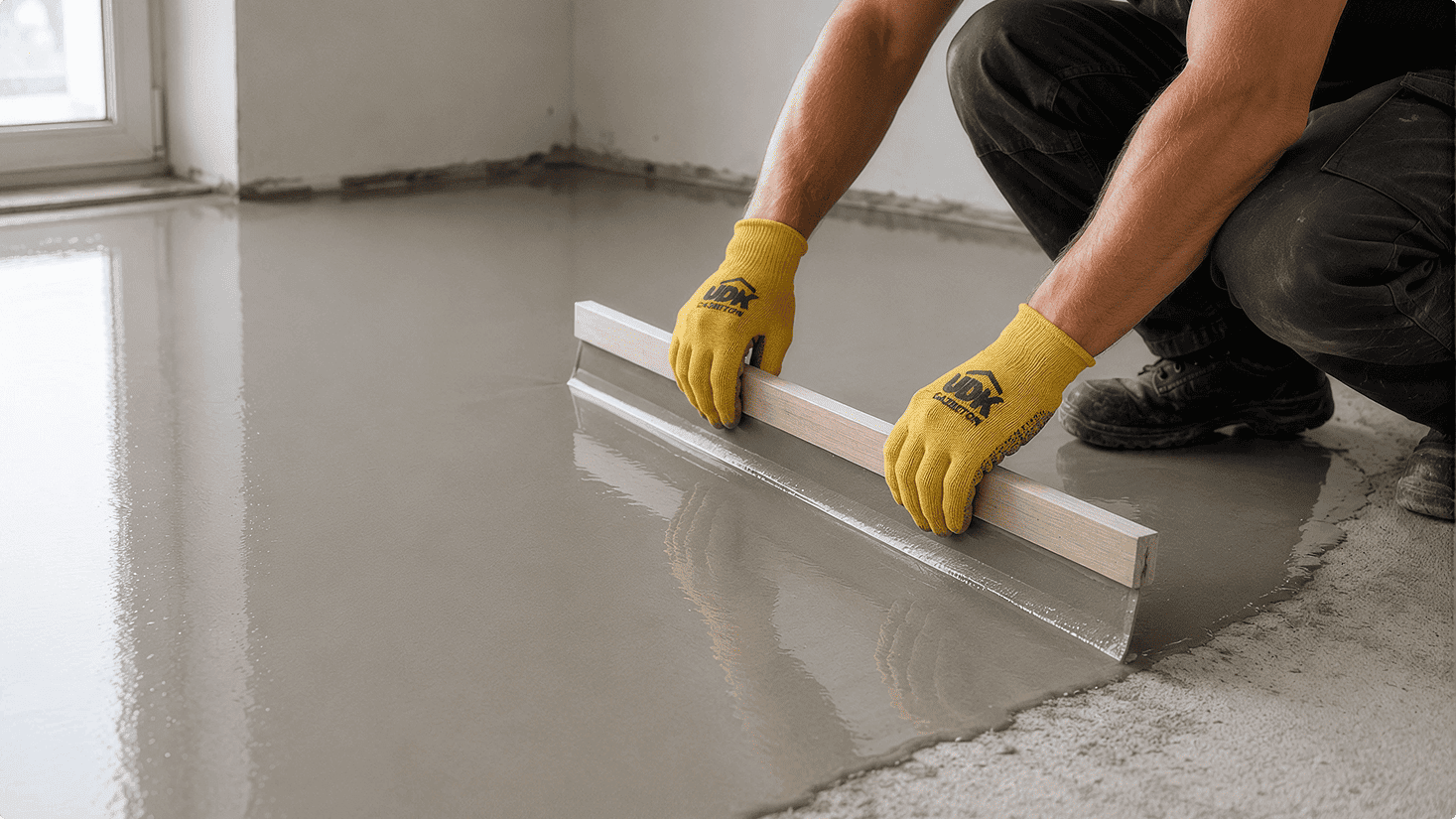
A self-leveling compound (self-leveling floor compound) is a specialized construction material used to quickly create a smooth and even surface. It is widely applied before installing laminate flooring, ceramic tiles, vinyl flooring, or parquet. The main advantage of this material is its flowability: once poured, it spreads evenly across the surface, filling cracks, dips, and other imperfections.
Self-leveling compounds are typically used when floor unevenness ranges from a few millimeters to several centimeters. They are suitable for both residential and commercial applications. They are especially useful during the renovation of older buildings where the existing subfloor has defects.
Self-leveling compounds offer several important benefits:
These advantages make self-leveling compounds one of the most popular flooring preparation solutions in modern construction and renovation.
Before starting, make sure you have the following tools and materials:
Having all the necessary equipment prepared in advance makes the process easier and helps prevent mistakes.
The quality of the finished floor depends largely on proper surface preparation. Thoroughly clean the substrate by removing dust, dirt, grease, and any remnants of old materials. Weak or damaged areas should be repaired or reinforced before proceeding.
If there are cracks or major defects, they should be filled with suitable repair compounds first. After that, apply a primer to the surface. Priming reduces water absorption and significantly improves the adhesion between the self-leveling compound and the substrate. Skipping this step is one of the most common causes of floor delamination.
Proper mixing is essential for achieving a strong and durable floor. Always follow the manufacturer’s instructions.
Start by pouring the required amount of water into the mixing container, then gradually add the dry compound while continuously mixing. Use a construction mixer until you obtain a smooth, lump-free consistency. The mixture should be fluid enough to spread easily but not overly watery.
Adding too much water weakens the finished floor, while an overly thick mixture will not level properly.
Work quickly, as most self-leveling compounds remain workable for only 20–30 minutes. For large areas, it is recommended to work with a second person.
The recommended application temperature ranges from +5°C to +25°C. Humidity levels also play an important role in the drying process.
The floor is typically ready for light foot traffic after 6–12 hours, while complete curing may take up to 72 hours. Before installing the final floor covering, ensure the surface is completely dry.
These mistakes can lead to cracks, uneven surfaces, or delamination of the finished floor.
A self-leveling compound is a simple and effective solution for creating a smooth, even floor. By following the correct application process, you can complete the work yourself and achieve professional-quality results. It not only saves time but also helps ensure the long-term durability of your flooring.
If you’re looking for a reliable product, consider UDK FL 50 self-leveling compound from the Ukrainian manufacturer UDK. It offers high strength, excellent flowability, easy application, and consistent crack-free performance. The compound is suitable for a wide range of substrates and is fully compatible with underfloor heating systems, making it an excellent choice for both residential and commercial projects.
For expert advice or to place an order, call: +38 (067) 996-83-77.

