Special Offer: UDK-Super 100!
Dear customers! New product in our range and a limited offer on the "UDK - Super 100!" bundle: partition blocks 600×500×100 + UDK TBM adhesive at the same price as the blocks alone without adhesive.


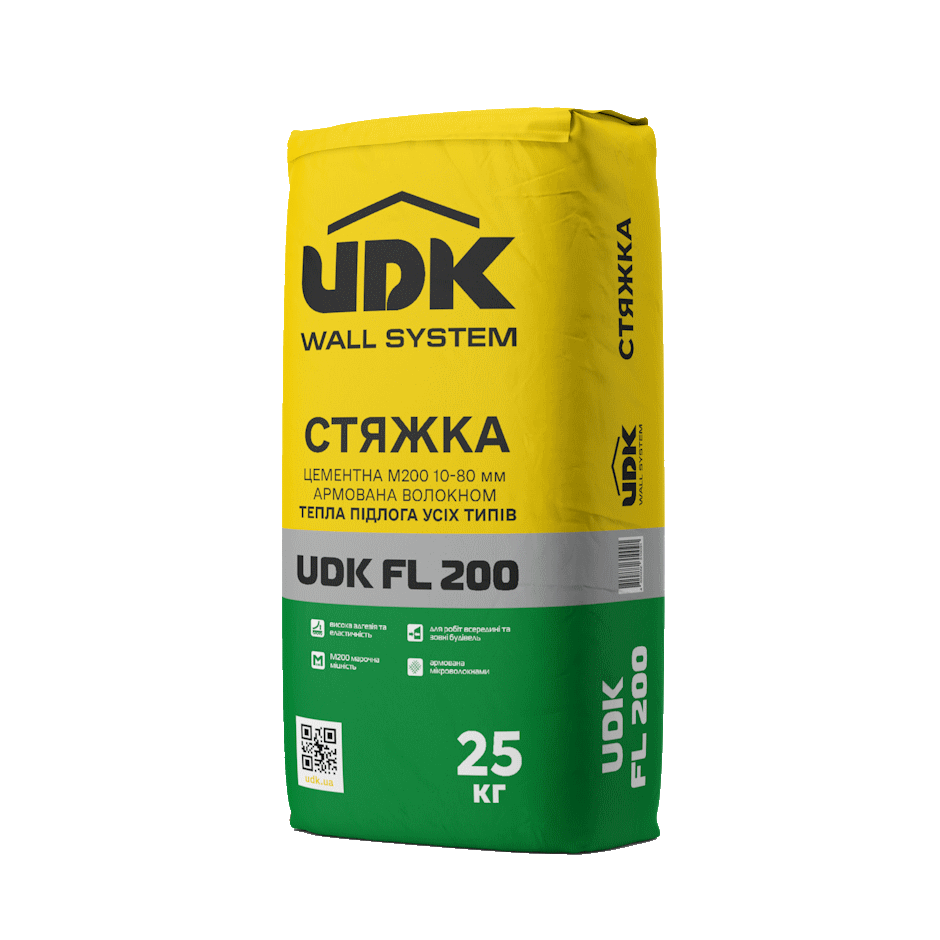
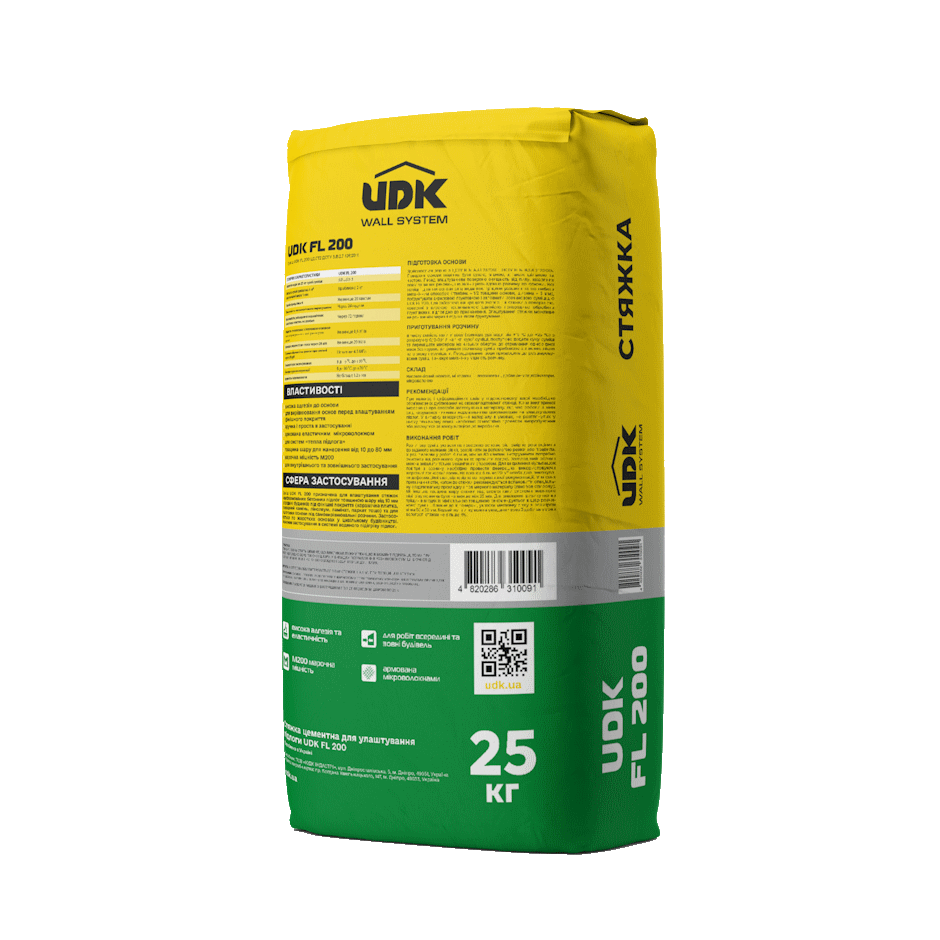
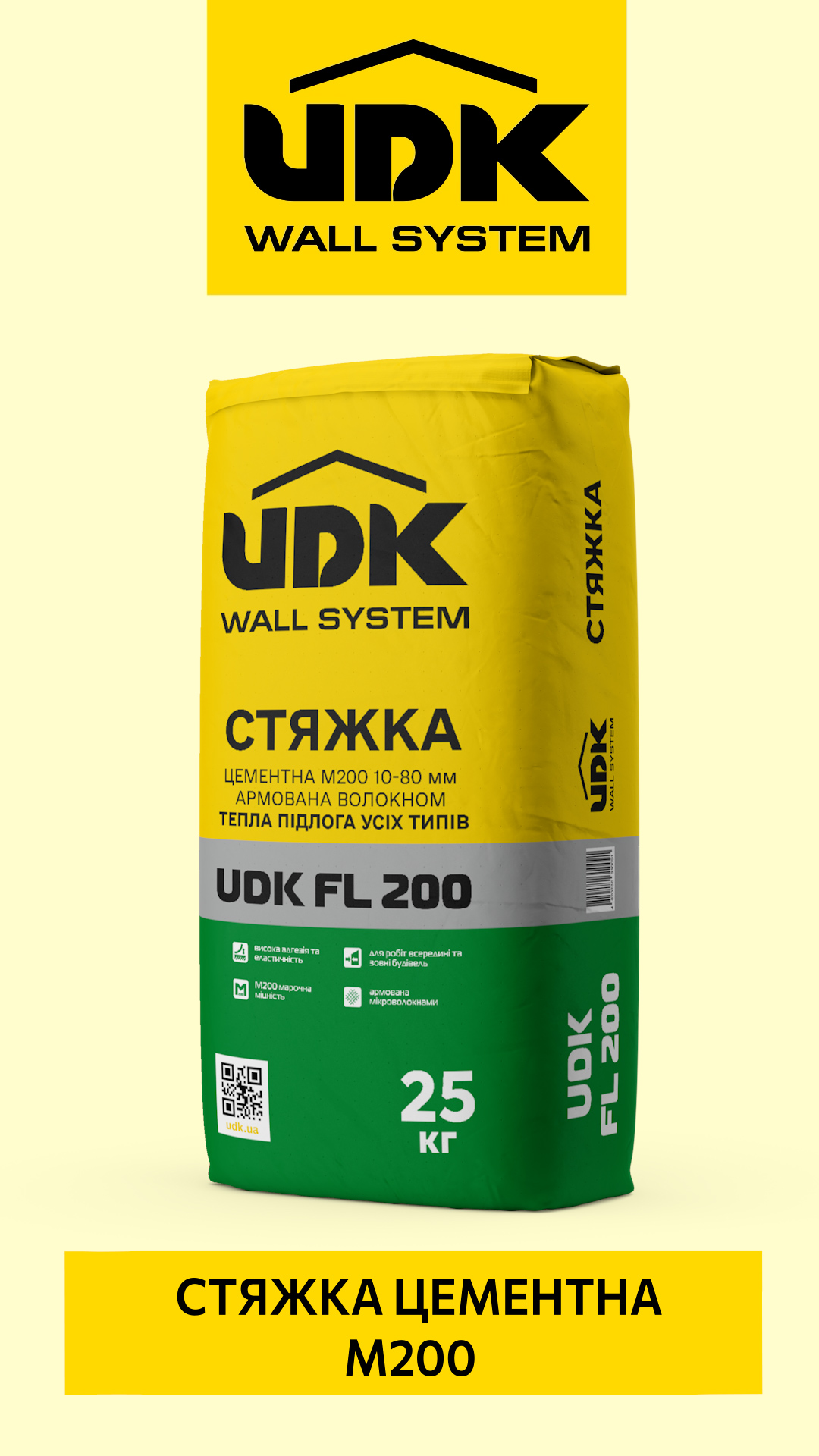
Fiber-Reinforced Cement Screed M200 10–80mm. All Types of Underfloor Heating
Recommended price

For interior and exterior use

For underfloor heating

High durability

Reinforced with microfiber
For interior and exterior use
For underfloor heating
High durability
Reinforced with microfiber
Mix UDK FL 200 Ts2.ST2 DSTU B.V.2.7-126:2011
UDK FL 200 mix is designed for installing screeds of non-deformable concrete floors with a layer thickness of 10 mm and above inside buildings, under finish coatings (ceramic tiles, natural stone, linoleum, laminate, parquet, etc.) and for preparing substrates for self-leveling compounds. Used on rigid substrates in civil construction. Suitable for use in underfloor water heating systems.
High-quality cement, mineral fillers, modifier additives, microfiber
Carried out in accordance with DSTU-N B A.3.1-23:2013 and DSTU-N B V.2.6-212:2016. The substrate surface must be dry, solid, dense, and clean. Before installation, the surface must be cleaned of dust, oil stains, and other substances that reduce adhesion of the mortar to the substrate. All weak areas of the substrate must be removed. Cracks must be opened and deepened mechanically (depth — 1/2 of substrate thickness, width — 5 mm), primed with acrylic primer, and filled with UDK FL 200 mortar mix. To ensure better bond of the screed to the surface, highly absorbent surfaces must be pre-treated with primers appropriate for the intended use. Screed installation is permitted no earlier than 4 hours after priming.
Pour water (water temperature from +15°C to +25°C) into a clean container at a rate of 0.12–0.14 L per 1 kg of dry mix, gradually add the dry mix and stir with a low-speed mixer until a homogeneous lump-free consistency is achieved. Allow the mortar mix to stand for approximately 5 minutes, then mix again. Over-watering leads to mix segregation and reduces the mechanical strength of the mortar.
Place the mortar mix on the substrate surface, distribute evenly to the level set by screeding guides, and level using a straightedge or float. If work is interrupted for more than 60 minutes, tools must be cleaned of mortar mix and rinsed with water. Hardened mortar can only be removed mechanically. To remove air bubbles from the mortar, deaeration must be performed using a rigid spiked roller. On areas larger than 20 m², expansion joints must be installed in accordance with applicable standards. At points where walls and columns meet the screed, it is recommended to install a special separating strip made of polymer material (expanded polystyrene). The minimum screed layer thickness over elements of a water heating system must be at least 25 mm. To reduce the risk of cracking at points of minimum thickness, it is recommended to embed a metal mesh with a cell size of 50×50 mm into the mortar mix layer, closer to its surface. Ceramic tiles may be laid after 3 days, provided the screed moisture content does not exceed 4%.
Where expansion joints are present in the underlying layer, they must be duplicated in the freshly installed screed. In addition to the application instructions provided above, all applicable standards for floor installation must be followed when working with this material. If the material is used under conditions not covered in this technical description, independent testing must be carried out or the manufacturer should be consulted.